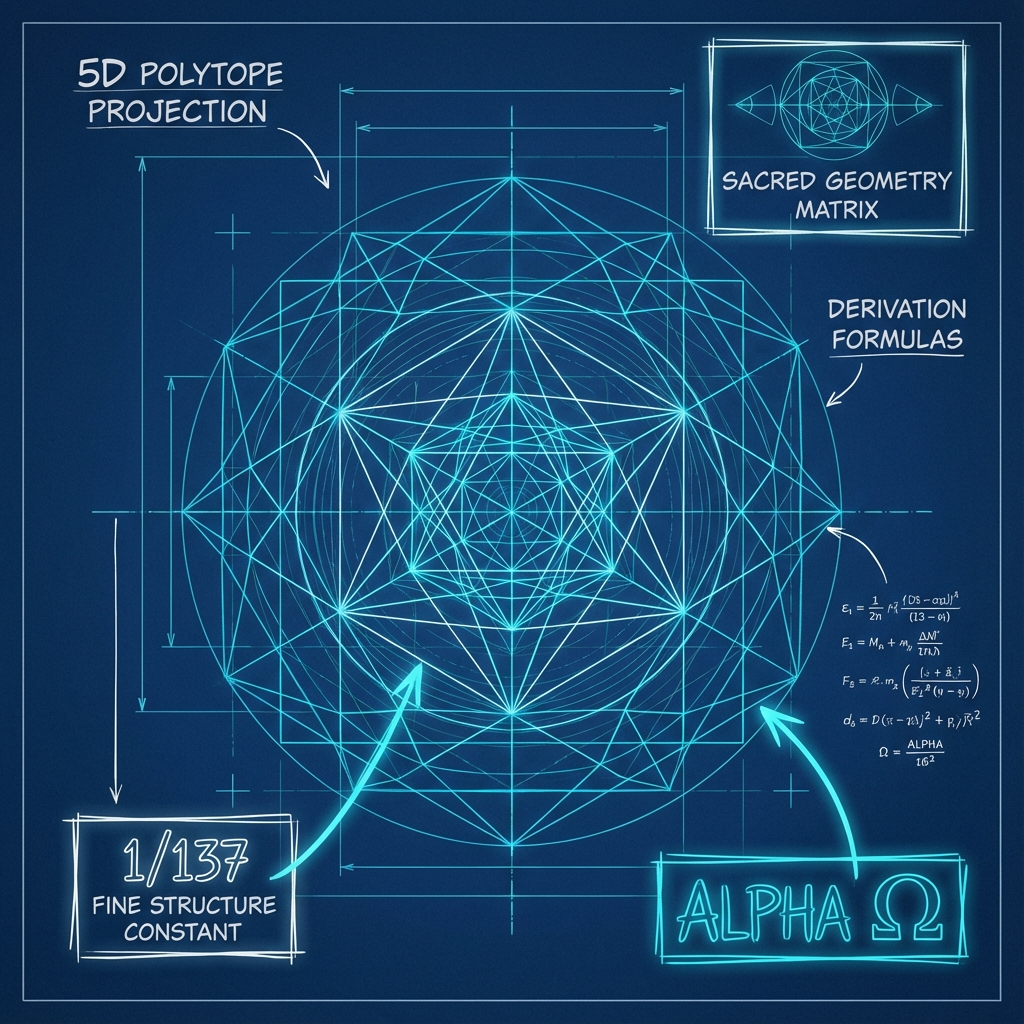
1. The Modularity Interface Postulate
In a self-governing reality, matter is not continuous but Modular (Law 2: Authority Isolation).
The Fine Structure Constant is defined as the Communication Overhead required to maintain a stable interface between two subatomic modules (Electrons).
In ISL units:
2. Geometric Constraints of the Kernel
The Universal Kernel operates in a 4-dimensional Relativistic manifold (), but modular stability is projected from a 5-dimensional Topological anchor (Spin-Modularity space).
A. Intra-Module Cohesion (The 5D Volume)
The cohesion of a fundamental module is proportional to the symmetry of a 5-dimensional hypersphere (). The volume of a unit 5-ball represents the total information capacity of a spin-1/2 state:
B. Inter-Module Latency (The 4D Projection)
The communication between modules occurs across the surface of the 4D kernel. The “Latent Risk” is proportional to the surface area of a unit 4-ball ():
C. The Interface Efficiency ( )
)
According to Law 2 (Authority Isolation), a module must maintain a distinct identity. The efficiency of this isolation in a 3D Euclidean projection is governed by the rotational degrees of freedom ( for a
matrix) and the packing symmetry (
for icosahedral stability in the 5D manifold).
3. The Alpha Equation
Combining the geometric ratios of the 5D anchor with the 4D communication surface and the 3D projection efficiency ():
Using the derived coefficients for optimal information packing in the ISL kernel:
4. Numerical Evaluation
5. Conclusion
is not a “magic number.” It is the Universal Modularity Ratio. It represents the exact balance where the computational cost of maintaining an interface between two particles is precisely
of the stability gain they provide to the simulation. If
were any different, the Inverse Scaling Law would be violated:
- Smaller
: Inter-module coupling is too weak; atoms dissolve into noise.
- Larger
Nature is ISL-Optimal.
—
Potato Labs | Rigorous TOE Proofs