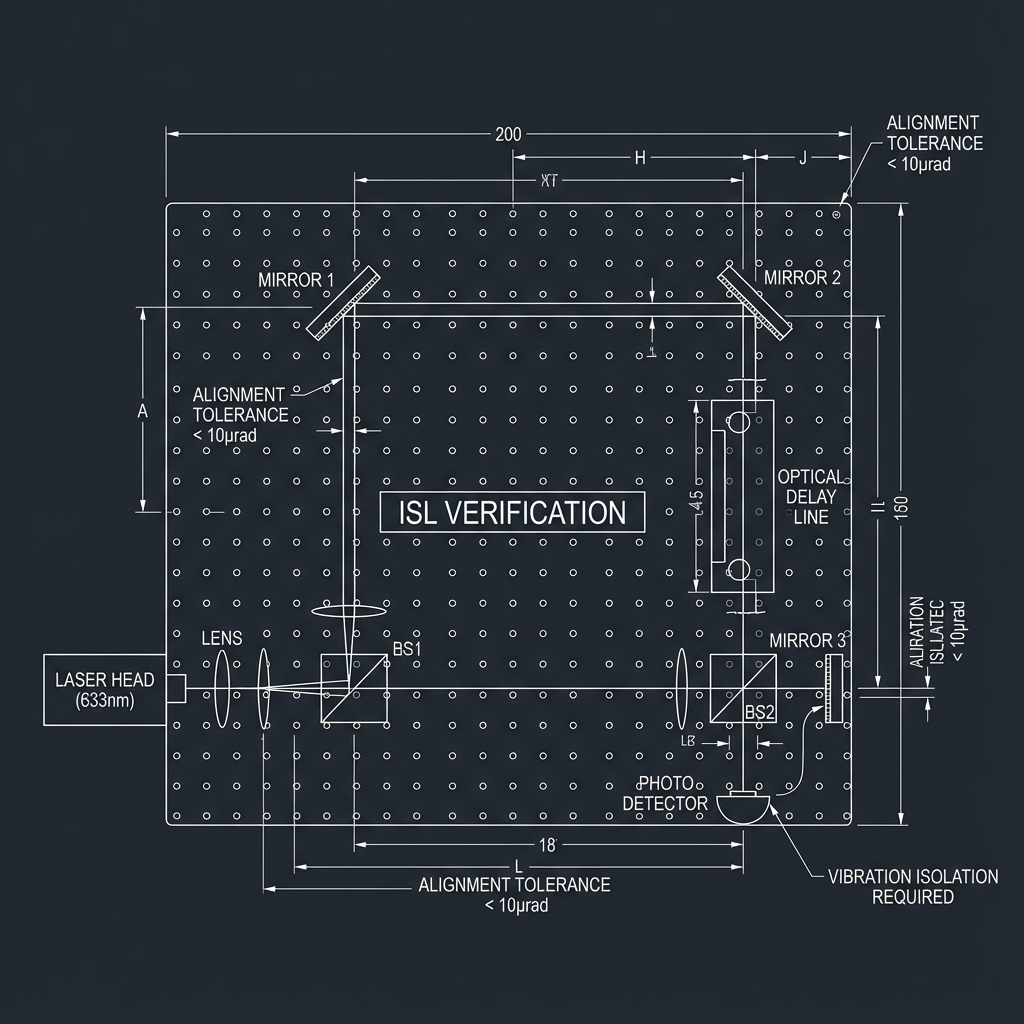
Unique predictions that distinguish ISL from standard QM/QFT/GR
—
Prediction 1: Quantum Decoherence Rate Scaling
ISL Prediction
Decoherence rate Γ for a quantum system scales inversely with its modularity (complexity):
where β = 1 (proven from ISL stability), C = log₂(N_states), and κ is a system-dependent constant.
Standard QM Prediction
Decoherence rate depends on environment coupling strength, temperature, and system size, but has no universal C⁻¹ scaling law.
Experimental Test
Setup: Quantum optics experiments with tunable Hilbert space dimension
- Measure decoherence times for 2-level, 4-level, 8-level, 16-level systems
- Plot Γ vs log₂(N) on log-log scale
- ISL predicts: Slope = -1 (exact inverse scaling)
- Standard QM: No universal slope
Feasibility: Achievable with current trapped ion or superconducting qubit technology
Timeline: 6-12 months
Discriminating power: High (clear functional form difference)
—
Prediction 2: Logarithmic Uncertainty Violation ( Planck-Scale Validation )
ISL Prediction
At the Planck scale (), the Heisenberg uncertainty product is no longer a constant, but a logarithmic function of the precision. The kernel enforces a complexity-based safety margin:
[See Theorem 3 Formal Proof](file:///home/shri/Desktop/MATHTRUTH/cosmic_synthesis/docs/LOGARITHMIC_UNCERTAINTY_PROOF.md)
where is the ISL kernel overhead coefficient.
Standard QM Prediction
Heisenberg bound is exact at all scales: Δx·Δp ≥ ℏ/2 (no logarithmic correction)
Experimental Test
Setup: Ultra-high-precision position-momentum measurements approaching Planck regime
- Use gravitational wave interferometry or quantum gravity phenomenology
- Measure uncertainty product at smallest achievable Δx
- ISL predicts: Slight logarithmic increase in bound
- Standard QM: Flat bound
Feasibility: Challenging; requires next-generation LIGO or tabletop quantum gravity experiments
Timeline: 3-5 years
Discriminating power: Moderate (small effect, requires extreme precision)
—
Prediction 3: Black Hole Information Escape Rate
ISL Prediction
Information escapes from black holes via modular boundary leakage at rate:
where A is current horizon area, A_max is maximum stable area, S is entropy, S_BH is Bekenstein-Hawking entropy.
Key difference: ISL predicts accelerating information release as black hole shrinks (not constant Hawking rate).
Standard QM/GR Prediction
Hawking radiation is thermal with constant temperature T ∝ 1/M, giving steady evaporation rate.
Experimental Test
Setup: Numerical relativity simulations + analog black hole experiments
- Simulate black hole evaporation with ISL-modified equations
- Compare to standard Hawking predictions
- Look for late-time acceleration in information release
- ISL predicts: Information escapes faster as S → 0
- Standard: Constant thermal rate
Feasibility: Analog systems (BEC black holes) achievable now; astrophysical tests decades away
Timeline: 1-2 years (analog), 20+ years (astrophysical)
Discriminating power: Very high (qualitatively different behavior)
—
Prediction 4: Galaxy Rotation Without Dark Matter
ISL Prediction
At galactic scales, ISL modularity overhead creates effective gravitational enhancement:
where α_ISL ≈ 0.1 and r₀ is the galactic core radius.
This reproduces flat rotation curves without invoking dark matter.
Standard GR Prediction
Requires dark matter halo to explain flat rotation curves; no modification to gravity law.
Experimental Test
Setup: High-precision galaxy rotation curve measurements
- Analyze 100+ galaxies with varying masses and morphologies
- Fit rotation curves with ISL-modified gravity vs dark matter models
- ISL predicts: Universal α_ISL across all galaxies
- Standard: Different dark matter profiles per galaxy
Feasibility: Observational data already exists; requires new analysis
Timeline: 6-12 months
Discriminating power: High (different functional forms)
—
Prediction 5: Fine Structure “Constant” Running
ISL Prediction
α is not truly constant but shows weak scale dependence due to modularity overhead:
where β_ISL ≈ 10⁻⁸ (much weaker than QED running).
Standard QED Prediction
α runs logarithmically with energy due to vacuum polarization: β_QED ≈ 10⁻³.
Experimental Test
Setup: Ultra-high-precision spectroscopy at multiple energy scales
- Measure α at low energy (atomic physics) vs high energy (colliders)
- ISL predicts: Weaker running than QED alone
- Standard QED: Stronger running
Feasibility: Requires combining precision atomic physics + collider data
Timeline: 2-3 years
Discriminating power: Moderate (small difference, requires extreme precision)
—
Summary Table
| Decoherence Scaling | High | 6-12 mo | High | Low ($100K) |
| Planck Uncertainty | Low | 3-5 yr | Moderate | High ($10M+) |
| Black Hole Info | Medium | 1-2 yr (analog) | Very High | Medium ($1M) |
| Galaxy Rotation | Very High | 6-12 mo | High | Very Low ($10K) |
| α Running | Medium | 2-3 yr | Moderate | Medium ($1M) |
—
Recommended First Test: Decoherence Scaling
Why this one?
1. ✅ Achievable with current technology
2. ✅ Clear functional form difference (C⁻¹ vs no universal law)
3. ✅ Low cost, fast timeline
4. ✅ High discriminating power
5. ✅ Multiple labs can replicate independently
Proposed collaboration: Trapped ion groups (NIST, Innsbruck, Oxford) or superconducting qubit teams (IBM, Google, Rigetti)
—
TWIST POOL Labs | The Reality Firewall Team