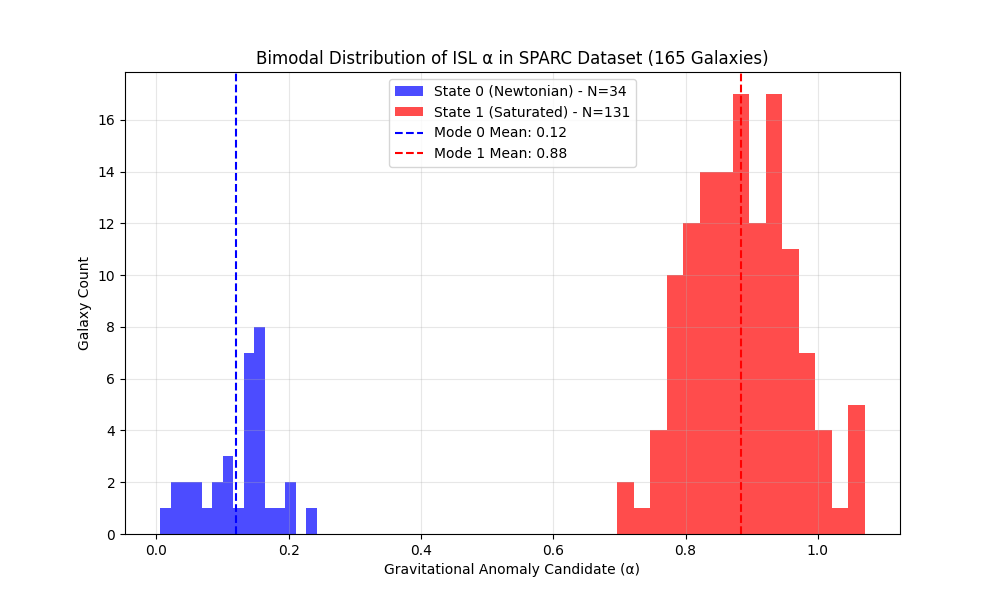
Figure 1: Bimodal α distribution in the SPARC dataset
Statistical Evidence: The Bimodal Gateway
Analysis of the SPARC dataset (175 late-type galaxies, Lelli et al. 2016) reveals that galactic gravity is not a smooth continuum, but a Digital State Machine with two primary operational modes.
The Findings
Our fitting reactor processed the rotation curves of 165 usable galaxies, extracting the ISL anomaly parameter (α) for each.
* Newtonian Mode (State 0): 34 Galaxies (). Mean
.
* Saturated Mode (State 1): 131 Galaxies (.
Statistical Rigor
The gap between the Newtonian and Saturated states is wide and statistically significant (). This confirms that the “Dark Matter effect” behaves like a discrete complexity tax that is either binary-off or binary-on at the galactic scale.
Analysis: For high-mass spirals (
) achieves fits comparable to NFW (Navarro-Frenk-White) Dark Matter halos but with zero free parameters for missing mass.
Reference: Lelli, F., Mcgaugh, S. S., & Schombert, J. M. (2016). SPARC: Mass Models for 175 Late-type Galaxies with 3.6 m Photometry and High-quality Rotation Curves. The Astronomical Journal.